
What we wanted to make
Have you ever actually finished a wish on a shooting star? By the time you think "oh!", it is already gone.
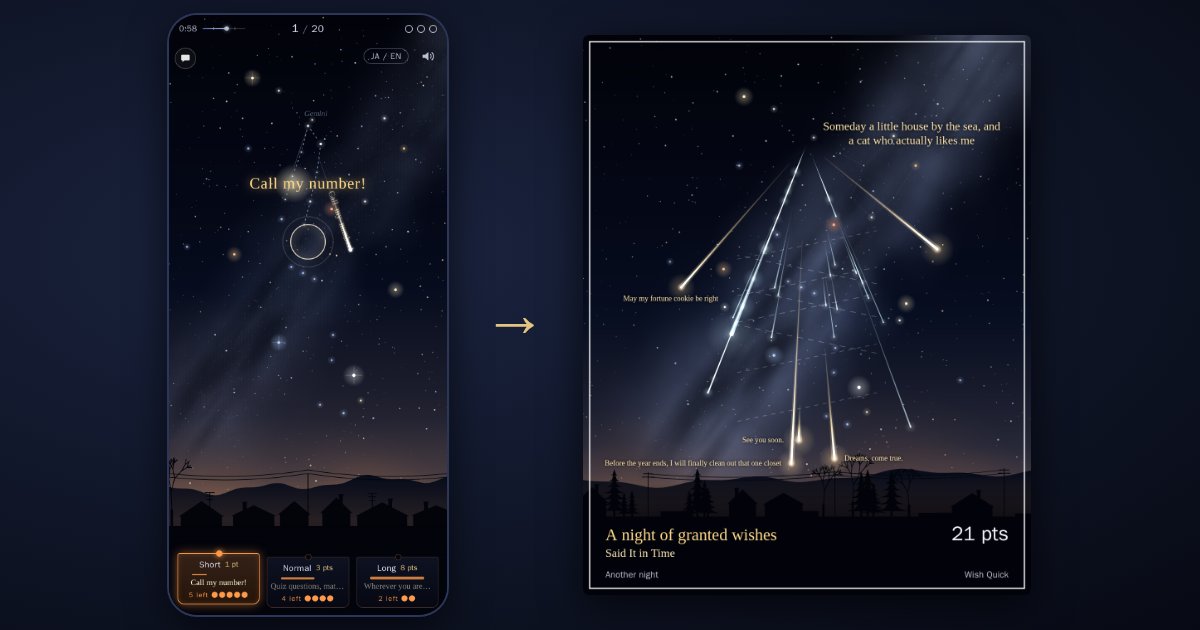
So we built a night sky where you can keep trying until you make it. Hold the screen only while a shooting star is shining, and the wish you loaded lights up one letter at a time. If the last letter lights before the star fades, the wish comes true.
Money, money, money!
A short wish is quick to finish, but small. A long wish is worth a lot, but only a long-lived star gives you enough time. You choose which wish to load before the star appears. And the sky is not empty: planes and satellites cross it too. Wish on a plane, and it turns into an embarrassing night.
What we cared about most: what you see is what happens
Your hold counts only while the shooting star is visibly shining. To make sure there is never a star you can see but cannot wish on, or a star that is gone but still counts, we stepped through whole nights in hundredths of a second and checked that the stars on screen always match the game's own record.
How long a star lasts is not random. Shooting stars spread out from around Gemini. The farther from Gemini one appears, the longer it shines. That is how a real meteor shower behaves. No star carries a mark telling you "this one is long". Read the sky and take your bet.
At dawn you get a photo with every star of the night stacked into one frame. It is drawn from the paths the stars really took that night, so the streaks fan out from a single point in the sky. The wishes you made stay written along their streaks.
What gave us trouble: reading the sky made you lose
In the first version, loading a long wish for every bright star was enough for a perfect score on your very first night. There was no reason to read the sky.
So we made brightness alone unreliable. Then the opposite happened: a run that read both brightness and position scored lower than a run that looked at brightness only. A long wish could only land if you pressed within 0.1 to 0.8 seconds of the star appearing, and reading takes longer than that. The more carefully you read, the more you lost. That was the worst possible shape for this game.
We lengthened the stars that appear far from Gemini, so a wish still lands when you read first and press second. Even so, reading brightness and position at the same time proved too much, and night after night the careful runs failed to come out ahead. In the end we cut it down to a single clue, distance from Gemini, and put clear space on screen between where the long-lived stars appear and where the quick ones do. We had automated players go through hundreds of nights and tuned the numbers until reading distance clearly beats watching brightness alone. The rule itself is now put into words in the stargazer's note at dawn.
The dawn photo also started out looking like a geometry worksheet. We stopped polishing the lines one by one and rebuilt it from the real paths of the night, and it finally began to look like a meteor shower photo.
One more thing. We built a record you could only push after a perfect score, and on most nights it never showed up. So we turned it into something every night can have: how close to the star fading you finished a long wish. Your closest call of the night also gets a small mark on the dawn photo.
What we'd love to hear
Honest feedback is the most useful kind. Even one answer helps.
- Did finishing a wish feel good? Was there a moment when you pressed and it did not seem to count?
- On your first night, was it clear what to do? Were there any marks or lights you could not make sense of?
- Could you tell which stars would last long enough for a long wish?
- Did the dawn photo make you want to show someone? What would bring you back for another night?
A little practice before the real shooting stars arrive.