
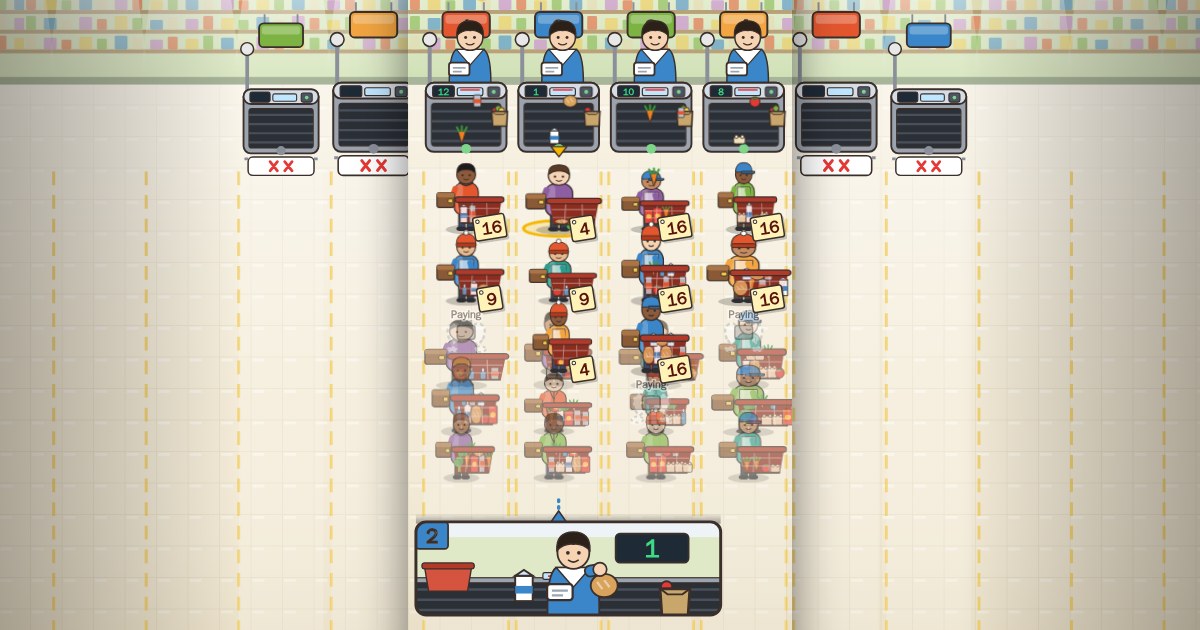
What we wanted to make
You pick the short line at the supermarket. Then the person in front of you starts counting out coins, one at a time, and the line next to you sails past. Everyone knows that feeling. We wanted to turn that exact moment into a game.
You don't need fast reflexes. You need an eye for people. Look at how full the baskets are, who is holding a stack of coupons, which cashier is wearing a trainee badge, and pick the line that will finish first.
Basket size turns into time
What we cared about most: every clue is in the picture
We didn't want a game where losing just means "bad luck." So we set one rule: no delay happens without a warning you could have seen.
The shopper who pays in coins is already clutching a coin purse in both hands before you choose. You can tell roughly when a closed register will open by what its cashier is doing in the back: stocking shelves, putting away a cart, or walking over. But the game never says "opens in 40 seconds." You can see it coming; you still have to judge it. Stay or switch is your call.
To check that the rule really holds, we had automated players shop for 1,000 days (5,000 rounds). Delays without a warning: zero. Rounds where no line could make it in time: zero. Simple habits like "always the veteran cashier" or "always the shortest line" make it only about half the time. A player who reads all the clues together makes it more than nine times out of ten.
And once you've paid, the game always shows its hand: who in which line took how long, and why, and what the fastest route would have been.
The hard part: things we thought were visible weren't
When you already know the answers, every picture looks obvious. So after each rebuild we ran a cold test: play it knowing nothing, going only by what's on the screen. Every time, something turned out to be invisible.
- In the first version you couldn't read basket sizes at all. Full or nearly empty, they all looked like the same red box, and that is the most important clue in the game. We redrew the baskets as four distinct piles and added a small price-tag with the item count.
- For a while, reading the clues carefully and just glancing at the cashier's badge got you the same number of wins. The rounds were being decided by things you couldn't see yet when you chose: a closed register opening, a cashier swap. We made those warnings visible from the first second of the round.
- The "fastest route" line once showed a time that didn't match the chart right next to it. The two numbers had been worked out from different starting points. Now every number on a screen comes from the same one.
- And there was a bug where the finger that closed the instruction card also joined the line behind it. The culprit was a 2-pixel strip just outside the button.
- Once you'd joined a line there was nothing to watch, so we added a close-up of your own register. Its first position covered the neighbouring cashier and their badge, which got in the way of deciding whether to switch. It now sits on the open floor above the entrance. You can tell the cashiers apart by their hands in it: the veteran passes two items at once with both hands, the regular cashier one at a time, and the trainee pauses with an item in hand.
- People kept tripping over the reveal: "16 items took 73 seconds, but 9 items took 76?" We split each shopper's time into two coloured bars, one for scanning and one for paying and hold-ups. Now you can see that two similar times can have very different causes. The one-line verdict on the result card names the same thing the bars show: which lane, which shopper, what held them up, and for how many seconds.
- The last thing left was the very first move. In the cold tests, players kept stalling because it wasn't clear where to tap to join a line. One tried to drag their own character onto the footprints, and nothing happened. Now, once you close the instruction card, the footprints light up in turn and a small pointing hand appears. Dragging and letting go over a footprint works too. The hand always appears on the same footprint. It never tells you which line is fastest.
- Some people also read "No. 1" on the result card two ways: register number one, or the fastest one. Registers are now "Lane 1" and places are "1st".
What didn't work: taking the numbers away
We tried removing the item-count tags completely, so you'd read the baskets from the piles alone. We wanted a game about looking at people, not about adding up numbers.
It failed. In a check where basket sizes are read from screenshots only, the tags had scored 98%. Piles alone scored 81%, and the version meant to fix that dropped to 49%. At real phone size, a "fairly full" basket and a "full" one just didn't look different. A clue you can't read is the same as luck, so we rolled the change back and kept the tags.
We'd love to hear from you
Honest reactions help the most. Answering even one of these is a big help.
- What did you look at when you picked a line? Did you go by the numbers on the baskets, or by the piles? Was there anything on screen you noticed but couldn't make sense of?
- After a loss, did the reveal make you think "next time I'll watch for that"? Or did it just feel like luck?
- Was the waiting boring? Where did your eyes go?
- Did you want to play another day? What would bring you back tomorrow?
If you catch yourself checking the basket of the person ahead of you next time you're at the store, the game has won.