
What we wanted to make
There are plenty of stargazing apps. But most of them open with a screen full of stars, and you are left wondering: "So where do I actually look tonight?"
We wanted an app that answers in one line the moment you open it.
Best around 5 pm: the Moon, halfway up the southern sky (three fists high)
We give heights in "fists" instead of degrees so you can stretch out your arm under the real sky and find it right away.
What we cared about most: never telling you something false
If a sky app says "Jupiter is here" and it isn't, you stop trusting it.
So we checked the positions of the Moon and planets against NASA's JPL Horizons, a real ephemeris, across dozens of dates and places. Mars and Jupiter are within 0.06° — far smaller than a fingertip.
Once, the drawing of the Moon's phase had the lit side on the wrong side. The tests passed; we only caught it by putting the picture next to a correct one. It's fixed now.
The hard part: words and pictures that disagreed
This took the longest.
The sky drawing would show Sirius, while the list below said "Sirius has already set tonight." Drag the time slider fast, and the clock moved on while the sentences stayed behind. Small mismatches like these kept popping up in new places no matter how many we fixed.
In the end we stopped fixing them one by one. We rebuilt the app so every sentence and button comes from one shared "state of the sky right now." Only then did everything line up. It's invisible work, but it's where most of the time went.
Born from a suggestion during development
While we were building, someone wrote:
If you could zoom in until you see the Moon's shape and surface, that would be amazing.
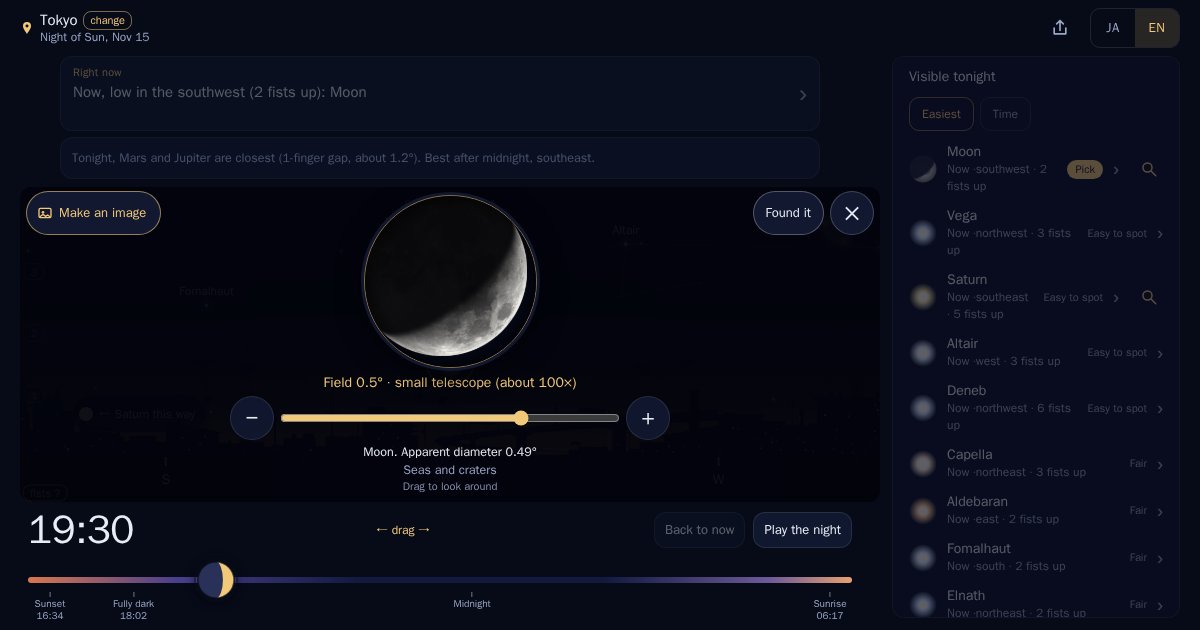
So we made "Take a closer look." Tap the Moon and you can zoom all the way into a real lunar map, lit exactly as it is that night. For Jupiter you see its bands and where its four moons are at that moment. All of it is calculated for that night only.
Something different every night
- Tonight's note: picks this week's highlight, like "Mars and Jupiter sit close together tonight." Tap it to jump to that sky.
- Moon collection: the Moon's shape on each night you look is recorded, slowly filling in from crescent to full.
Tell us what you think
Honest feedback means the most to us. Even one answer helps.
- Right after opening, did you know where to look tonight?
- When you looked up at the real sky, was it where the app said? Did "fists high" help?
- How did it feel to zoom in on the Moon or Jupiter?
- Would you open it again tomorrow night? If not, what would make you want to?
On a clear night, try it outside.