
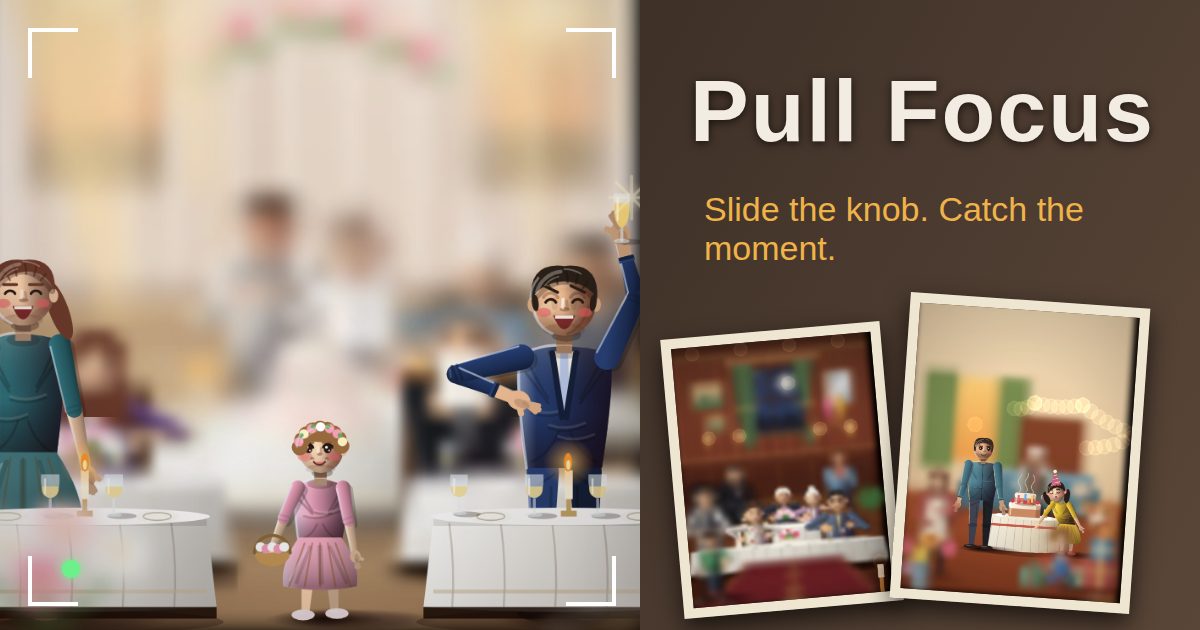
What we wanted to make
Have you ever been "the one with the camera" at a birthday or a wedding? The candles go out and your focus is sitting on the cake behind them. You shoot the toast, and every arm is already back down. We wanted to turn that small heartbreak into a game you can play in a minute or two.
There are only two controls: a focus dial and a shutter. In a room where the kid up front and the grandmother at the back are both moving at once, you read who is about to have their moment, pull focus to them early, and wait.
You get 12 shots. The last party gives you 11
What we cared about most: the player who reads the room gets the shot
We set two rules. A photo is exactly the screen at the instant you pressed. The blur stays. The closed eyes stay. Nothing is redrawn afterwards. And no moment arrives without a tell. Before the candles, a deep breath. Before the toast, a glass on its way up. Before the tears, a trembling mouth.
But play the same party a few times and you simply learn the timings. So once you've passed a party, its moments shift a little on every run after that. We checked this with automated players: one that presses at memorised times drops from three of the three requested photos to two, then one. One that watches for the tells keeps getting all three.
We also worked on making "12 shots" actually matter. In the first version you finished with four to six frames to spare whatever you did. We added a moment book (how many of a party's moments you caught cleanly in a single run), but it still never forced a choice between the requested photos and the book. We tried three ways of creating that choice while keeping 12 frames, measured each, and none held up. So the last party has one frame fewer. Chase the book and miss twice, and there is nothing left for Grandma at the end.
What you shoot also changes the rest of the party a little. Someone whose photo you caught waves at you right afterwards; someone you missed lets out a small "Oh…". Catch Sou's surprised face at the birthday and he sits down on the floor to play with the robot he just unwrapped. Catch the toast at the wedding and the friend who gave it keeps his tie wrapped around his head until the party ends. Any photo you take after that shows them that way, and so do the closing line-up of the three who asked and the picture you save.
The hard part: making people look like people on a small screen
The figures gave us the most trouble. Tapered arms, shadowed folds in the clothes, shading on cheeks and noses: zoom in and you can see each change, but at real phone size the new version looked just like the old one. That happened seven times. So we changed the approach and made places where faces are large: a close-up frame that appears right after you catch a requested photo, and a closing scene where the three people who asked for photos stand side by side. We redrew that scene around posture rather than expression. Someone you caught faces you with their arms up. Someone you missed turns slightly away, shoulders down. Nobody scolds you.
A few other things we built, then rebuilt:
- After every rebuild we ran a cold test: play knowing nothing, going only by what is on the screen. In one of them, two full runs produced zero requested photos. Making the cue louder changed nothing. What worked was not starting the clock until the first touch, and showing "Request caught!" or "So close" right after each shot.
- The feel of the shutter. We lengthened the white flash, and it still didn't show up in screenshots taken straight after the press. We stopped tuning the duration and made the test "the very next frame must show the shutter curtain." Only then did it feel like a camera.
- Small fixes broke things elsewhere. Changing the layer order for the photo that flies to the film counter left the focus dial floating over the results screen. Guarding against accidental double taps made "See results" impossible to press once the film ran out. Both were fixed quickly, and since then every change is followed by a pass that taps every screen and every button once.
- We drew people waving when you caught their photo, and at first nobody could see it. On a catch, the "Request caught!" card popped up right on top of them. On a miss, your focus was somewhere else, so their slumped shoulders were lost in the blur. Moving the card to the opposite side, and adding a small speech bubble over the head on a miss, finally made it visible.
- The words on the results screen. A title and a comment that followed the rules exactly were read by a newcomer as "saying opposite things." We now list every situation a line can appear in (no photos at all, photos but none of the requested ones, a near miss) before writing it.
We'd love to hear from you
Honest reactions help the most. Even one answer is useful.
- In the first party, what made you press the shutter? Did you notice the tells, or were you watching the "Soon…" and "Now!" label at the top?
- When a photo came back "out of focus" or "So close," could you tell why, and what to do differently next time?
- In the last party, did you ever hesitate between a requested photo and a moment for the book?
- Did you want to send your album to someone? Would you open tomorrow's daily party?
If, at your next get-together, you catch someone taking a deep breath and reach for your phone, the game has won.