
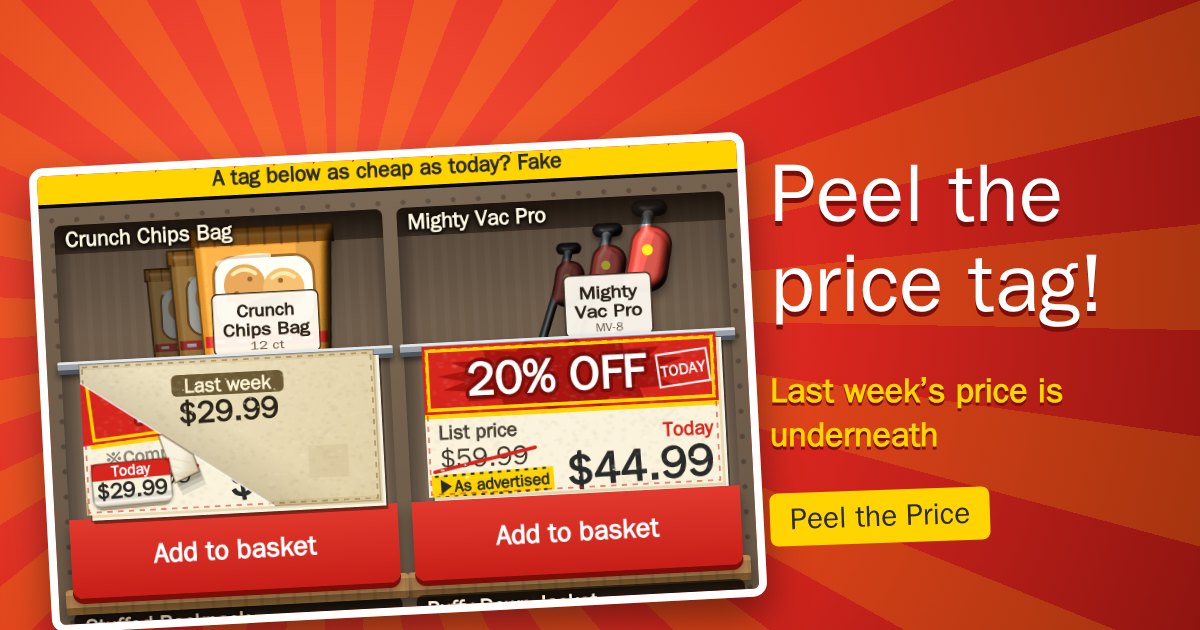
What we wanted to make
You see a big red SALE tag and wonder: is this actually cheap? If the "regular price" quietly went up last week, 50% off saves you nothing.
So we built a store where you can peel the tag with your finger and check. The tags are stuck on top of each other. Peel one back and last week's tag is underneath, and the week before that.
Real only if today beats every tag underneath
That one line is the whole rule. But peeling takes time, the store is about to close, and other shoppers keep walking off with things. You can't peel everything.
What we cared about most: you only know what you actually uncovered
We didn't want a tag that pops open when you tap it. Pinch a top corner and pull down, and the paper follows your finger. Let go and it stays where you left it. Flick it fast and that one sticker rips clean off.
And we made one promise: a price counts as "seen" only when its digits are really showing on screen. Under a half-peeled tag, neither you nor the game knows the number yet. We stepped through more than a thousand frames of finger movement to confirm that what's drawn and what's recorded never disagree.
There is no warning that says "this one is a fake" before you buy, and no running total of how much you've saved. The only answer sheet is the receipt after closing time.
What gave us trouble: peeling just one layer was enough to win
In the first version you could peel only the top sticker on every item, buy whenever today was cheaper than last week, and end up with nearly double the target. Reading the clues, like off-center glue or the fine print, actually did worse.
So we added more items where last week looks expensive but a cheaper tag hides two or three layers down. We had automated players run each of the four stores 500 times and tuned the numbers until trusting the top layer wins only about half the time, and reading the clues and digging deeper comes out ahead.
One more. On a four-layer tag, the bottom price could stay hidden behind the half-peeled paper while the tag already looked finished. You'd think you had checked everything and buy a fake. That was the worst kind of mismatch. Now every price you uncover stays lined up as a small card, the "more below" count drops one at a time, and the end mark appears only when you really reach the bottom.
We also started with a single store. When we turned it into four stores with their own signs and tag styles, rice crackers showed up on the electronics shelf, so each store got its own list of what it can sell. Every store and product is made up, and we drew all of them ourselves.
What we'd love to hear
Honest reactions help the most. Even one answer is great.
- Did peeling the tags feel good? Was there a moment it didn't do what your finger meant?
- In the first store, was it clear what to do? Any picture or number you couldn't make sense of?
- Looking at the receipt, could you tell why you saved money (or why you got fooled)?
- Did you want to try another store? What would bring you back?
Warm up your fingers before the real sales start.