
What we wanted to make
You recorded tonight's match. You don't want to know the score until you're home. But your phone won't stop buzzing. Mum's "pick up milk" you have to read. Your friend's "NO WAY" you really, really shouldn't.
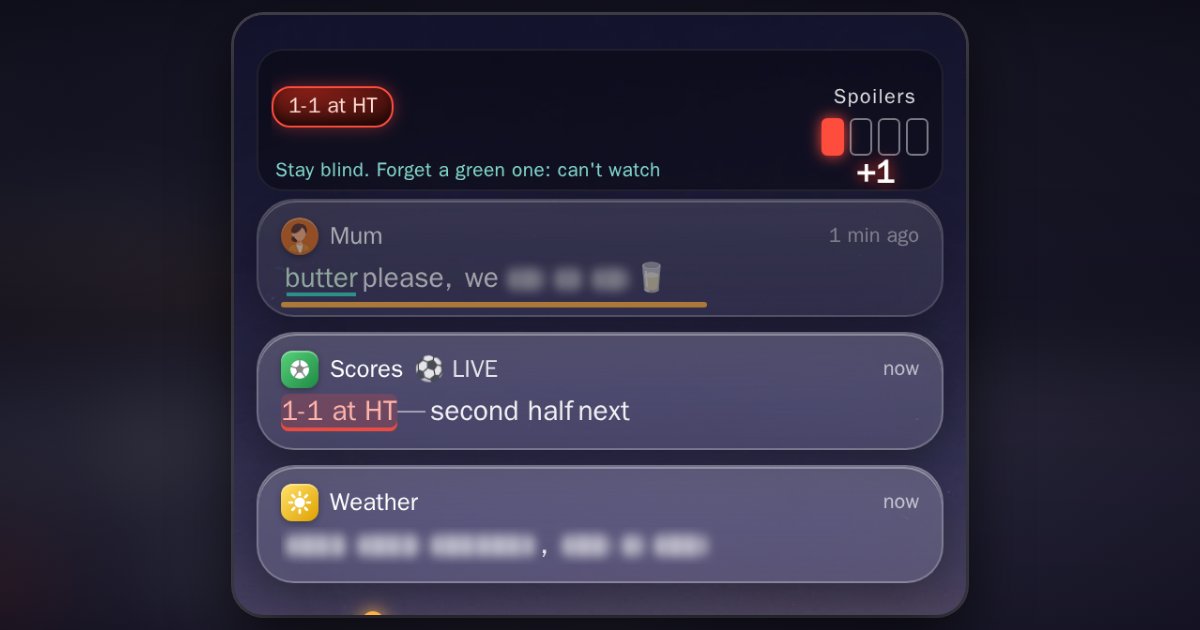
We wanted to turn that cold sweat into a game. It's the opposite of a hidden-object game: the point is not to look. Every notification arrives blurred, and only the words under your finger open up. How far you swipe is up to you.
Get home blind. 4 spoilers ruin it
What we cared about most: only the words under your finger open
This game falls apart the first time it says you "knew" something you never read. So we set one rule and held every change to it: only the words visible under your finger open, and only opened words count as known.
Hidden words aren't anywhere on the screen until you open them. We recorded hundreds of finger movements and compared, one by one, the words that opened with the words that were under the finger at that moment.
We rebuilt the notification cards several times so they'd pass for a real lock screen. At first every opened word sat in its own box and the hidden parts were plain bars. Now there are no boxes: opened words read as ordinary text, and hidden ones are just the blurred shapes of words.
There is no tutorial screen. One line in the bar at the top of the lock screen tells you the goal.
The hard part: words opening when you didn't mean to read them
The thing we kept fixing longest was words opening by accident.
The first version had the opposite problem: slide your finger in from outside a card and nothing opened at all. Playing it cold, as a first-timer would, it took 75 seconds to read the first notification. After the fix, about 4.
But once cards opened easily, they opened too easily. A vertical flick across the screen revealed words. A new notification pushed the cards down, and a tap a moment later opened "1-1 at the break" on a card you weren't aiming at. Each time we added one small rule: wait until the finger's direction is clear, ignore taps for a split second after a card moves.
Then there were the loopholes. You could tell a safe notification just from who sent it. Work, the train line, the courier: read them all, no risk. So we wrote notifications where a safe-looking sender tacks the result onto the end of an errand. After that, stopping at the first full stop won every time. So we wrote ones where the errand is in the second sentence.
We slipped up in the final replay too. In matches that went to extra time or penalties, the score and the clock appeared to jump backwards. A check that only looked at the numbers passed; we caught it only by stepping through the moving screen frame by frame.
What changed when we played it as a first-timer
While building it, we played from the very start six times as someone who knew nothing about the game, and fixed what tripped us up.
- "I can't tell what counts as winning." → The bar at the top of the lock screen now states the goal in one line.
- "I never saw a single spoiler and still couldn't watch the recording." → The same bar now says that forgetting your errands costs you the recording too.
- "The question changed and my tap answered the new one." → For a brief moment after a question changes, taps don't count as answers.
- "After switching language on the results screen, 'Play again' wouldn't start." → Fixed.
Tell us what you think
Honest feedback means the most to us. Even one answer helps.
- On the first screen, did you get what the game is? How long did it take?
- Did a word ever open when you didn't mean to read it? If so, when?
- Did you read differently the second time? What made you think "this one's dangerous"?
- How did it feel to watch the recording without knowing the result (or to be locked out of it)?
The word just past where your finger stopped: check the results screen afterwards to see what it was.