
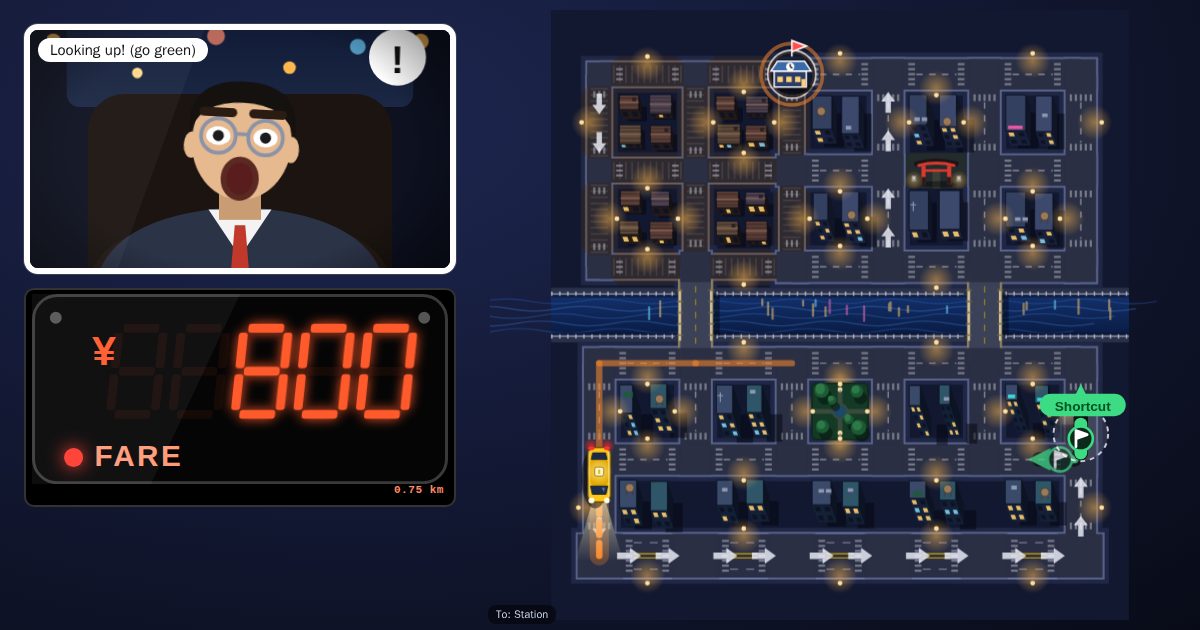
What we wanted to make
Ever sat in a taxi and thought, "Isn't this the long way?" If you'd been looking at your phone, you probably wouldn't have noticed at all.
We wanted to put you in the other seat. You're the driver. The longer the route, the higher the meter. But if your passenger looks up from their phone while you're heading away from the destination, you're caught.
Orange = detour (earns). No press = shortcut
All you do is tap an arrow at the next intersection. When your passenger is about to look up, go green. That is the whole game.
What we cared about most: what you see is what happens
If the screen and the rules each decide for themselves what counts as "getting closer", sooner or later they disagree. Get caught once while driving on a green road, and you'll never trust the game again.
So the arrow colours, the passenger's eyes and the rise in suspicion all come from one calculation. We count the streets one by one: a road that brings you nearer the destination is green, one that takes you farther is orange. The one-way streets are in that count, and so is the fact that there are only two bridges. When we checked, colour and rule matched at all 182 spots, and the passenger in the mirror matched what they were really doing all 224 times.
The receipt works the same way. The line of your route, the × where you were seen, the reason you lost a star and the passenger's parting words are all built from the record of that one ride. The number in "Regular fare ¥1,000 → Actual fare ¥2,400" is the last number the meter showed.
The hard part: doing nothing earned more
We had the first version tried by a player who knew nothing about it. It went badly.
Back then, the taxi drove straight ahead unless you pressed something. So in the ten seconds the player spent thinking, the first passenger simply arrived. Left alone, the taxi wandered off on detours by itself, and the run where the player did nothing earned more than the run where they played, and was awarded "Detour Master". The receipt disappeared after a few seconds, before it could be read.
So we changed one rule. If you don't press, the taxi always takes the shortcut. A detour happens only when you tap for it. Do nothing and you stay an honest driver, paid the regular fare. And the receipt now stays until you dismiss it.
We re-measured the difficulty too. Running fixed play styles through hundreds of simulated days showed that plain, sensible play met the quota nine times out of ten, while about four in ten of the times a player was caught were cases of "I saw the warning and pressed, and still didn't make it." We raised the quota from 1.5 to 2 times the regular fares, and made the warning before a passenger looks up last longer.
We fixed what passengers say when they catch you, as well. You'd be caught driving the wrong way and the local would shout, "That's my house. Twice." That line belongs to passing the same street twice. Now the line matches the reason.
Even then, the next first-time player was still reading when the taxi rolled past the first intersection, so their tap landed on the one after it. Now, for a new player's very first passenger, the taxi waits five seconds before pulling out. Tap an arrow and it leaves at once.
The city map began as rounded lines and flat squares. We redrew it so the streets look like streets and the buildings like buildings.
One piece of homework is left. We wanted a player who reads the streets carefully to earn more than one who simply plays it straight, and when we measured, that wasn't the case. We tried several sets of numbers and none fixed it, so that one carries over.
Tell us what you think
Honest feedback means the most to us. Even one answer helps.
- Right after opening it, did you know what to do? Could you tap your first arrow when you wanted to?
- When your passenger was about to look up, did "made it" and "didn't make it" feel fair?
- Did the receipt make you laugh? Would you show it to someone?
- Did you reach the quota? If not, did you want another go?
Just don't tell the passengers.