
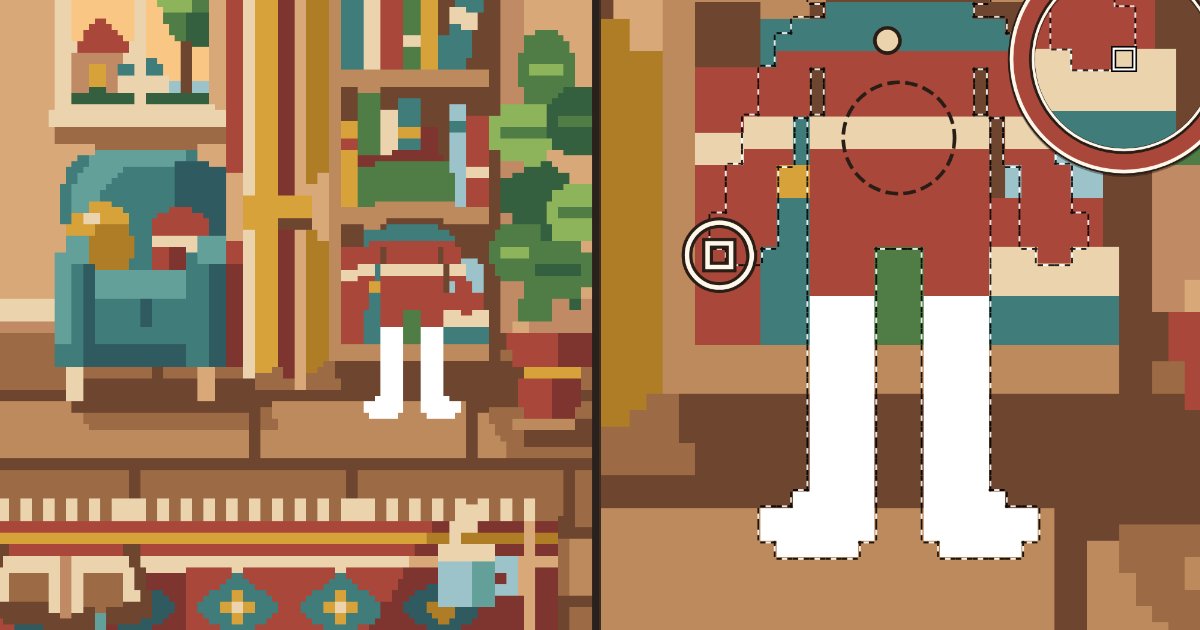
What we wanted to make
You know the kind of hide-and-seek where you paint yourself the colour of the wall behind you. We wanted that on a phone. When we looked at similar games, almost all of them were 3D matches that need everyone online at the same time, and players kept saying the same thing: hiding in a pitch-dark corner beats any clever paint job.
So we made one you play alone, with a fingertip. Pick up colours from the room, paint them onto yourself, and where you get it right you really do disappear. Then send your hiding spot as a link, and whoever opens it has to find you.
Paint yourself into the room
What we cared about most: what you see is what happens
No shortcuts, and no hidden rules.
- A square painted with a colour taken from the room is identical to the background, down to the pixel. The room and the paper figure share one grid and one palette, and they are merged into a single picture before it is scaled up, so no edge ever bleeds.
- The three seekers (a sleepy cat, an owl in glasses, a goat with a lens) look for you using only the colour differences visible on screen. There is no secret score, and there are no dark corners.
- While you paint, the game does not show a blend number. You step back and judge with your own eyes.
- We did not let you trace through a see-through body. Hold "Peek" and you see what is behind you only while you hold it. Peek, remember, paint.
- There is no button to switch between picking a colour and painting. Tap the room to pick, drag across your body to paint.
- The link carries the hidden picture itself. Nothing is stored anywhere.
- Each spot's multiplier is out in the open too. You see "Bookshelf ×1.6" before you choose where to hide. A harder spot only makes your run score bigger; it never changes whether you are found.
The living room, the kitchen and all three seekers were drawn square by square. The areas that end up behind your body are kept as broad, paintable shapes; the lamps, shadows and small objects went into the upper wall and the front of the floor, where a body never stands.
What was hard: closing the loopholes, again and again
The biggest fight was against easy wins.
- One foot was so small that a seeker missed it even when it was left white → we made the feet bigger.
- Smearing your body sideways in front of the plain wall got you past all three seekers without another stroke → we added a rule: a spot you have already used is closed for the rest of the run. Now the game is about where to hide next. It is not a rule hidden inside the seekers; the used spot is marked on screen.
- Even then, stepping just across the edge of a spot, or crouching at the very front of the floor, let old paint carry over. We had automated players try every standing position, found this twice, and closed it by widening the closed strip and making the floor shallower.
- In Safari-family browsers only, a single pixel of mixed colour appeared where two squares met, which nearly broke the promise that a painted square matches the background → we aligned the width the picture is drawn at.
Playing it again from scratch, as someone who knows nothing, turned up more.
- "90 left" did not read as seconds → it now says "90s left", and says the clock waits for your first stroke.
- After a score of 0, nobody knew what to fix → the result now says what stood out and what to try next.
- The finger that tapped "Skip" also hit the button that appeared underneath → we moved the button.
- People lost their own well-hidden figure → its outline now glows, but only when you need to move it.
- A nearly finished paint job seemed to score 0 → the number was simply caught mid count-up. It now shows the real score from the first frame.
- Dropping the figure made it jump down to the floor → while you drag, its feet now stay on the floor it can stand on, and that floor is shown.
- In the harder spots nobody could tell how to raise their score → when you are found, the part that gave you away briefly shows what was really behind it.
What we'd love to hear
Honest reactions help the most. Even one answer is great.
- When you stepped back, did your figure feel gone? Which spot gave you the best vanishing moment?
- When you were found, could you tell why? Tell us about any result that felt unfair.
- Picking colours, painting, peeking, moving the figure: where did you get stuck?
- Did you want to send your hiding spot to someone? If you didn't, what was missing?
We hope your "can't see me" ends up on somebody's screen.